

Science
Mr M Lowe – 2nd in charge, KS4 Science Coordinator
Dr V Ntokorou – 3rd in charge, KS3 Science Coordinator
Mr M Hunnable – Head of Year 9
Mrs C Davies, Assistant Headteacher
Mrs D Shah
Miss M Palfreyman
Ms G Chiocca
Mrs E Dickinson, Assistant Headteacher
Mr C Blackburn
Support Staff
Mrs P Puzhakkal – Senior Science Technician
Dr K Van Den Dolder – Learning Intervention Assistant
Mrs H Colvert – STEM Coordinator
Ms C Rose – Science Technician
Ms R Bedwell, Learning Intervention Assistant
Learning is at the heart of everything we do. We believe all our students deserve a broad and ambitious science curriculum. Our curriculum is rich in skills and knowledge which inspires curiosity and prepares our pupils for further education and employment. We aim for our students to be successful in their exams and equipped to understand how to use data and evidence to draw conclusions, challenge ideas, develop problem solving skills, make decisions and reflect on these decisions. The overall goal of this is to enable pupils to improve their futures, and the futures of others.
In order to achieve this, we look beyond our own schemes of work. We liaise with the local feeder schools to ensure a seamless transition from key stage two into key stage three (KS3); and our key stage three curriculum is designed to provide the foundational knowledge required to thrive at key stage four (KS4). Our KS3 is mapped to the National Curriculum and our KS4 adheres to the AQA specification which we believe is the best foundation for A-Level science and builds a greater understanding of science moving into the wider world. As well as this, we have cross-curricular links with Maths and English as pupils must be able to record, interpret and display data as well as write and evaluate methods for investigations. Maths and investigations skills are delivered to Y7 students as their first introduction to Science. There are also links to other subjects such as; Physical Education, History and Geography within the curriculum. The links between the separate sciences of Biology, Chemistry, and Physics in KS4 are made overtly clear during the teaching programme
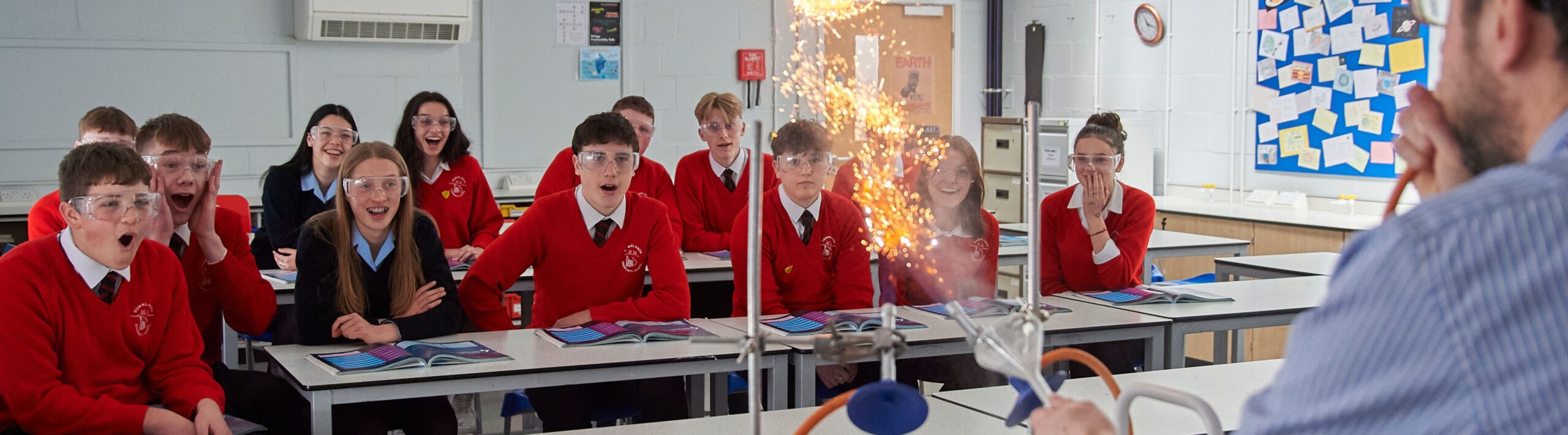
However, we do not just teach theory. Our science schemes of work are designed to provide the pupils with lots of opportunity for hands-on activities such as investigations, simulations, demonstrations, models, and excursions. We also teach topics gradually using a spiral curriculum so everything is revisited multiple times and the complexity of each topic increases through the years. We aim to incorporate cognitive science into our planning; ensuring pupils learning objectives are set using Blooms taxonomy and incorporating the zone of proximal development into planning these objectives. Also, our lessons are also planned with cognitive load theory in mind; eliminating the ‘noise’ from our activities so our pupils can develop their understanding of the important concepts.
Along with the scientific concepts, we also ensure we are teaching key skills that will help pupils in their day-to-day lives, such as literacy and maths. As well as this, to ensure we are identifying and closing gaps in knowledge, new topics and concepts are met with a form of diagnostic assessment to ascertain the prior knowledge of the pupils. Again, in the classroom, our lessons involve regular recall and retrieval practice, with structured interleaving and spacing which ensures pupils are retaining key concepts. This approach has been driven by our understanding of cognitive science and also enables teachers to identify and address misconceptions. We use targeted intervention for pupils with SEND and/or PP, both in and outside of the classroom to ensure ambitious outcomes for all. In order to make sure pupils can see the relevance of what they are learning, our schemes of work are kept up to date, relevant, and engaging. They also reflect diversification in science as our body of knowledge is drawn from scientists working all over the world. We celebrate women in STEAM and the impact they have on the scientific community. We incorporate a science careers programme within our schemes of learning, and are now putting a focus onto welcoming external speakers from diverse backgrounds coming into school and enlightening students on the rich possibilities provided by a career in the science field. Within this approach, there are numerous opportunities for pupils to be creative and develop their understanding with the support of a teacher.
Key concepts within the curriculum:
Biology – Cells, Bioenergetics, Response, Reproduction, Ecology.
Chemistry– Atoms, Chemical Reactions, Rates of Reactions, Earths Resources, Chemical Analysis.
Physics – Forces, Energy, Matter, Motion, Waves.
| Year Group | Investigative skills | Maths skills |
| Y7 | Describing patterns | Means, anomalies, ranges |
| Y8 | Key terminology/language | Significant figures, decimals |
| Y9 | Variables and methods | Graphing |
| Y10 | Methods and evaluations | Algebra, balancing equations, data interpretation |
Examining Board: AQA click on button below for more information
- Combined Science – Student obtains 2 GCSEs.
- Separate Sciences – Student obtains 3 separate GCSEs in Biology, Chemistry and Physics.

Our Communities
All students at Downlands belong to one of 4 Communities, all named after areas of natural beauty in Sussex
- Beacon
- South Downs
- Weald
- Wolstonbury